
Many rotator cuff injuries and shoulder pain improve with conservative treatment—targeted rehabilitation and, in selected cases, injections—without the initial need for surgery. Dr. Andrea Pintor evaluates each shoulder in Guadalajara based on the evidence.
Common causes
The most common ones in consultation are:
- Tendinopathy and partial rotator cuff tears.
- Subacromial impingement due to overuse or poor mechanics.
- Adhesive capsulitis (frozen shoulder).
- Injuries after fall or dislocation.
- Referred neck pain confused with shoulder.
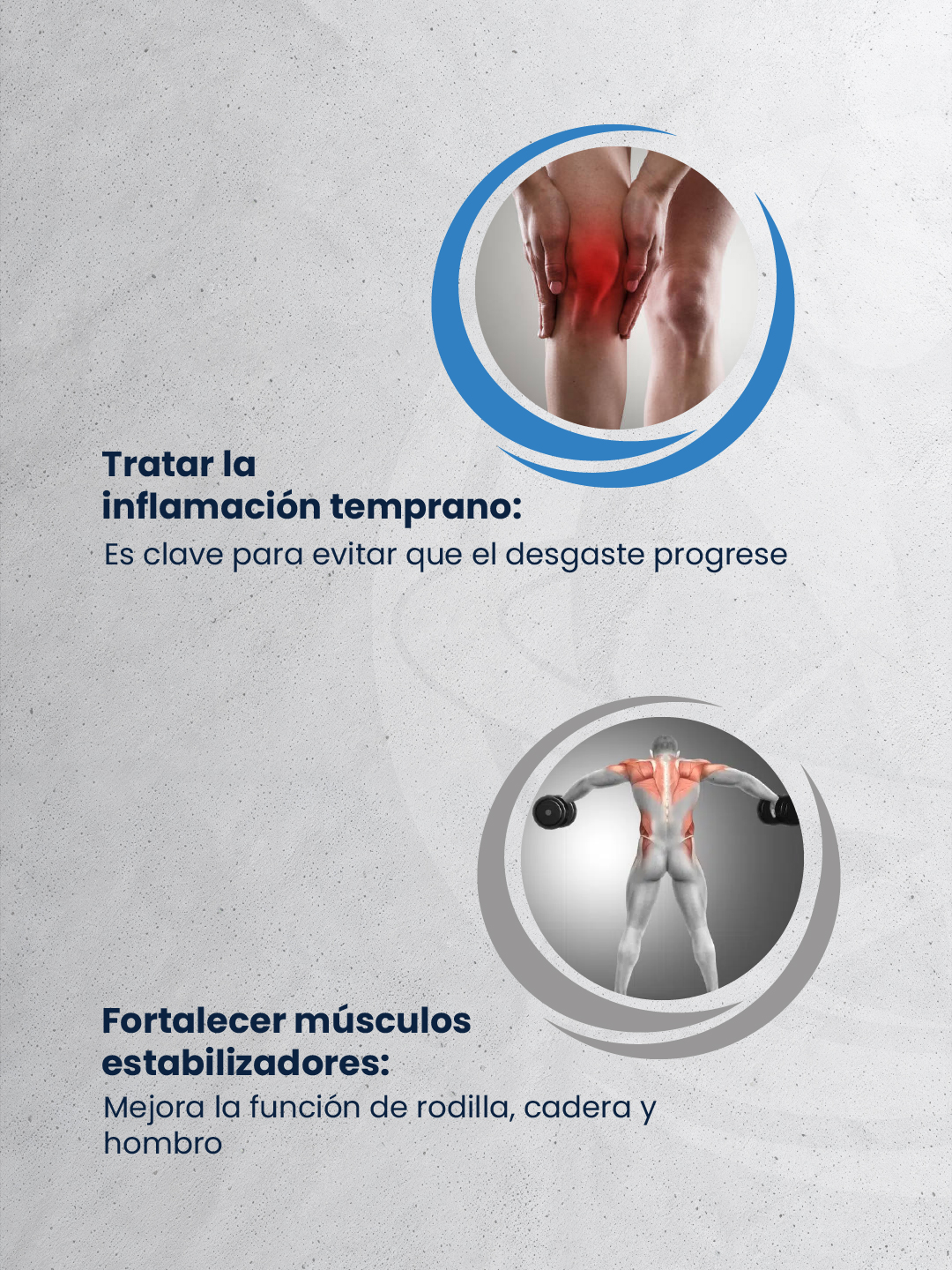
Joint wear and pain
How the wear and tear of a joint progresses and why it should be evaluated before losing mobility.
Signs that warrant prompt assessment
Loss of strength to raise the arm, night pain that prevents sleep on the affected side, or inability to raise the arm after a blow.
Conservative treatment
It is supported by specific rehabilitation of the cuff and scapula, pain management and adjustment of activities. injections are used selectively, to allow progress in rehabilitation, not to replace it.
What is the rotator cuff and why does it hurt?
The rotator cuff is the set of tendons and muscles that surround the shoulder joint and give it stability and movement. Pain can have two main origins: degenerative, due to wear and tear that accumulates with age and use, or traumatic, after a blow or effort. Degenerative changes in the cuff are very common with advancing age and not all of them produce symptoms: many people have changes in the cuff without pain [16]. When there are symptoms, the typical thing is pain on the outside of the shoulder that increases when raising the arm or sleeping on that side, along with loss of strength; Night pain is one of the complaints that most frequently leads to consultation.
What the evidence recommends first
For a significant portion of rotator cuff injuries, especially degenerative ones, initial treatment is conservative: targeted rehabilitation focused on regaining shoulder mobility, strength, and control, along with pain management [15]. Well-structured exercise programs allow many patients to improve pain and function without surgery [15][16]. injections may be considered in selected cases as part of the plan, to control pain and facilitate rehabilitation; Regenerative options such as PRP are considered with the same caution as in other joints.
Shoulder Rehabilitation: What to Expect
The work progresses in stages: first recovering the range of motion and relieving pain, then progressively strengthening the muscles that stabilize the joint and, finally, reintegrating the movements and loads of daily life or sport [15]. Consistency is decisive: exercise programs show benefit when carried out in a sustained manner, not with isolated sessions [15][16]. Abandoning rehabilitation at the first improvement is a common cause of relapse.
When is surgery considered?
Rotator cuff surgery is reserved for specific situations: traumatic tears in active people, or cases that do not improve despite well-performed conservative treatment [15][16]. The decision depends on the type of injury, age, functional demand, and patient goals. In many degenerative cases, conservative management is a reasonable and effective first-line option.
Frequently asked questions
Does every rotator cuff tear require surgery?+
No. Many partial and degenerative tears improve with well-directed rehabilitation. Surgery is planned depending on the type of injury, age, functional demand and response to treatment.
How long does frozen shoulder recovery take?+
It is a long process, usually lasting several months in phases. With constant treatment, function is recovered in most cases.
Does shoulder pain always need surgery?+
No. A good part of rotator cuff injuries, especially degenerative ones, improve with conservative treatment; surgery is reserved for specific cases [15][16].
Why does my shoulder hurt more at night?+
Night pain is a common discomfort in rotator cuff problems and is usually a reason to go for evaluation.
How long does it take to recover from a rotator cuff injury?+
It depends on the type of injury and the case, but shoulder rehabilitation usually requires several weeks of sustained work; Consistency directly influences the result [15].
Does cuff wear always cause symptoms?+
No. Many people have degenerative rotator cuff changes without pain; therefore treatment is guided by symptoms and function, not just by imaging [16].
You may also find helpful
References
- 1.Dickinson RN, Kuhn JE. Nonoperative Treatment of Rotator Cuff Tears. Phys Med Rehabil Clin N Am. 2023;34(2):335-355.
- 2.Jain NB, Khazzam MS. Degenerative Rotator-Cuff Disorders. N Engl J Med. 2024;391(21):2027-2034.
Educational content with clinical review by Dr. Andrea Pintor. It does not replace an individual medical evaluation.